Exhibition Gabrielle Hébert | English version
WARNING
The quotes reproduced in the exhibition respect Gabrielle Hebert’s original spelling and syntax.
Please note that some of the pieces presented in the exhibition may be shocking to some visitors.
INTRODUCTION (HALL)
An amateur painter and wife of the artist Ernest Hébert, director of the Académie de France in Rome, Gabrielle Hébert first took up photography at the Villa Medici in 1888, throwing herself into the discipline with much enthusiasm. She abruptly put away her camera for good twenty years later in La Tronche upon the death of her husband, whom she idolised and who was her senior by almost forty years. She ensured his legacy by establishing two museums devoted solely to him.
Just as Henri Rivière, Maurice Denis and Émile Zola picked up a camera in the late nineteenth century to document family life, Gabrielle developed her own private and sentimental practice encouraged by the technological and aesthetic revolution brought about by snapshot photography. As shown by the entries “I take photographs” or “I photograph” in her diary, not a day went by when she wasn’t taking photographs.
From her first ever shots to her final pictures, this exhibition presents what Gabrielle made of photography and what photography made of her. As she carved out a place as an artistic photographer in a milieu dominated by men, she truly found herself. By chronicling her favourite place and some of the happiest days of her life, she created a visual memoir and established her place in history.
A WOMAN UNDER THE INFLUENCE (Une femme sous influence)
On 21 July 1888, Gabrielle “popped out to buy essential paraphernalia for photography”. This was the start of her near-obsessive fascination with photography that resulted in some two thousand pictures, most of which were taken at the Villa Medici where, as the wife of the cultural institution’s director, she was expected to host receptions and entertain important guests.
Gabrielle soon found time outside of her formal duties to pursue her passion: she bought a camera and took lessons with Cesare Vasari, a professional photographer from Rome, and with fellow resident Alexis Axilette set up a darkroom for developing and printing her negatives and retouching the images.
She already had a good eye thanks to her cultural education and experience in painting and drawing. The countless photographic prints her husband collected of his artistic discoveries (sites, monuments and artworks) had a profound impact on the budding photographer.
But it was when Gabrielle met Giuseppe and Luigi Primoli, two French-Italian brothers described as “photography junkies and addicts” by the writer Romain Rolland, that she began to explore the full potential of snapshot photography, becoming the subject of a creative and existential experiment: photography.
A JOYFUL ARTFORM (Un art de la joie)
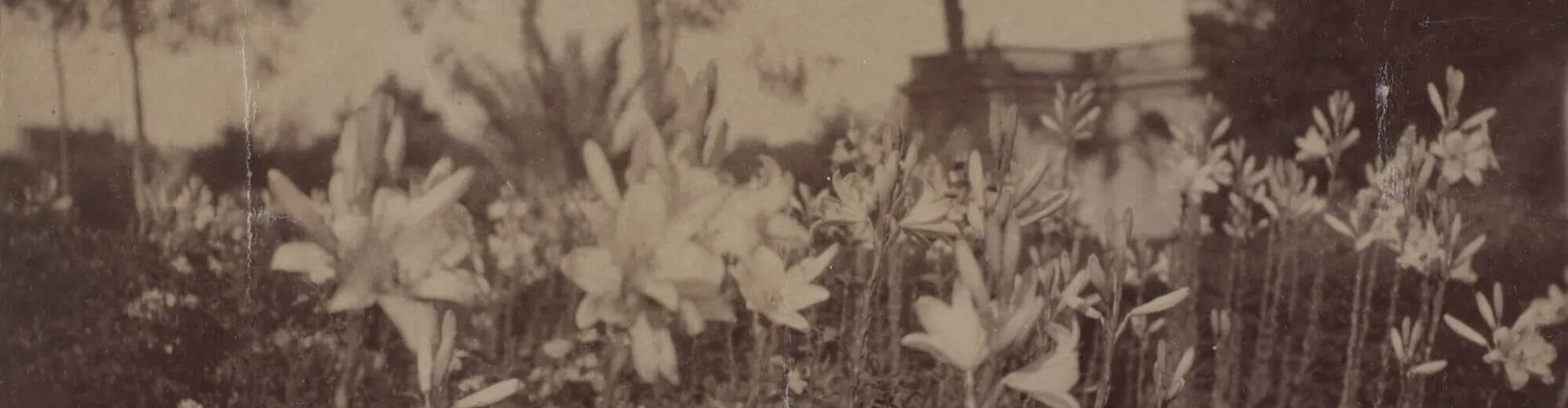
Gabrielle produced a chronicle of the Villa Medici, at once an architectural masterwork dominating the eternal city, a residence for the winners of the Grand Prix de Rome and a place of experimentation for a new form of relationship between France and the recently “unified” Italy. She directed her gaze toward the other occupants: artists and models, foreign visitors at leisure, Italian employees at work, flowers and animals.
She enjoyed taking photos along with other “button -pushers” in her circle, as amateur photographers equipped with hand-held cameras were called, whether they were artists, friends or even the French ambassador to the Holy See. She also observed professionals taking pictures of the palace using their impressive view cameras.
“Beautiful weather. I photographed the residents”: The day’s weather often gave Gabrielle an irresistible urge to capture images. Engaged with her surroundings, she found joy in the act of documenting her life. The act of taking a picture was like an epiphany. “I photograph therefore I am”, it seemed to mean.
MEIN ALLES (MY EVERYTHING) (Mein Alles, Mon tout)
Gabrielle was very much focused on her husband, circling around him and seeming to catch him unawares when he was painting or showing guests around. The tender and intimate portrait she created of him portrays him as a director and a consummate artist dedicated to his work at his various places of work (the garden next to his studio, the bosco, the top of a hill, and even his bed), or drawing in nature on one of his trips. She also photographed him nude in his later years bathing in the sea, carefully documenting these occasions. She was concerned about his health; she would keep a record of how he slept and what time he got up.
The couple’s unequal dynamic, typical of that time and social milieu, also comes through in their correspondence: while he addresses her in French using the informal “tu”, she uses the formal “vous” and calls him by the superlative “Mein Alles” (my everything). This relationship is also echoed in their artistic practice: Ernest is the main subject of her photography; he painted her on just two occasions.
TRAVELS AROUND ITALY (voyages en Italie)
During their eleven years living and working in Italy, Ernest and Gabrielle travelled all over the country. They visited villas and gardens, chapels and cathedrals, palaces and graveyards. The artist took great pleasure in returning to his favourite places, which he had painted in his youth. They would invite with them a resident or a student, such as Amelia Scossa, Ernest’s preferred model, or some of their friends; their dogs went wherever they did. In 1893, they went to Sicily, to stay at the estate of the major collector Henri d’Orléans, Duke of Aumale, then went on to visit the ancient sites of Selinunte and Agrigento and the Greek theatres at Syracuse and Taormina.
Outside of the Villa Medici’s four walls and away from its unusual occupants, Gabrielle was lifted physically and mentally from her environment. With genuine sensitivity to the local culture and people, she had a knack for getting strangers, women and men, to pose in front of her lens – no doubt mounted on a tripod – in lively arrangements around local landmarks like fountains or on the steps outside a building, her subjects then drawn to her work with curiosity.
A CINEMATOGRAPHERS VISION (En espagne, un regard cinématograhique)
In 1896, the household packed up and left Italy with heavy hearts, reluctantly returning to Paris and La Tronche where the socialite couple enjoyed a busy social life and Ernest received plenty of public and private commissions. Two years later, Gabrielle made her photographic swansong on one last trip, this time to Spain, which led the pair from Burgos to Grenada via Madrid, the Escorial, Toledo and Seville.
Swapping her view camera for a Kodak camera, she produced nearly three hundred pictures, building on techniques she had experimented with previously: bold perspectives – particularly from a speeding train – a moving camera, subjects looking at the camera, the photographer’s shadow projected on the ground, motion blur of figures and objects (smoke, clouds, waves), truncated figures and close-ups. Early cinema had also been influential. She no longer asked her subjects to pose but snapped them spontaneously, capturing fleeting gestures, glorious moments, the casual wandering of passers-by, a burst of laughter. The trip was a wonderful opportunity for the couple to get back on track one last time.
MEMORIAL OF AN ARTIST (Le tombeau d'un artiste)
Back from Spain, Gabrielle abandoned the pursuit of her passion, born under Italian skies.
Her output sharply dwindled before stopping entirely in 1908, when Ernest died. During his last months, she documented his final visits and outings in the sun, his strolls and the positioning of his easel before the subject. She depicted him as an artist and painter right until the end, then composed his posthumous portrait for posterity.
Already anticipating the end, the photographs of shared moments, places they’d travelled to and people they’d met were in actual fact meant to be seen by others beyond just their creator. With her thousands of images, Gabrielle created a tombeau, in the poetic sense – a memorial to her husband and their love.
In the museum she established in Isère, at La Tronche, dedicated to Ernest’s glory, her photographic work wouldn’t be discovered until the early 2000s, and then only by lucky accident.


