Arcabas Rétrospective | English version
Introduction
The creative output of artist Jean-Marie Pirot, known as Arcabas, spanned nearly eighty years. Even as a teenager, he knew his destiny lay in painting, and he set himself the task of celebrating the beauty of Creation – not from a mystical perspective, but through the things he observed everyday.
Following in the footsteps of the great masters, he combined great mastery of line with a talent for colour. Throughout his career, he explored both figurative and abstract art, merging them into an artistic language of his own. Whilst certain twentieth century artists tried to deconstruct the notion of beauty through increasingly abstract and conceptual representations, Arcabas sought to reveal it through a multifaceted body of work. Rejecting all conventions, both in his subject matter and his techniques, he asserted his freedom as an artist by following his own paths. This is seen in his unique approach to form and his use of gold: all hallmarks of his creative identity.
To mark the centenary of Arcabas’s birth, this retrospective allows visitors to discover an exceptional collection of paintings created during his life. These works echo those created by the artist for the Church of Saint-Hugues in Saint-Pierre-de-Chartreuse – now the Arcabas Museum – where a selection of works focusing on the theme of water is also on display this year.
BIOGRAPHY
Jean-Marie Pirot, known as Arcabas
1926 – Born in Trémery (Moselle). He loved drawing and began learning the technique at the age of 13.
End of 1943 – Forcibly conscripted into the German army following Germany’s annexation of Alsace and Lorraine, with 130,000 other young men who would come to be known as the ‘malgré nous’ (those conscripted against their will). The war was a traumatic experience for him.
He was admitted to the Paris School of Fine Arts, where he studied under Nicolas Untersteller (1900-1967). He discovered the Bible, which became one of his sources of inspiration, and he identified himself as a Christian.
1948 – Married Jacqueline Barrucand in Paris; her mother came from a Savoyard family.
1950 – Appointed teacher at the School of Decorative Arts in Grenoble, where the couple settled. Birth of Jean-Étienne (1952) and Isabelle (1954).
1952-1953 – Designed the interior of the church in Saint-Hugues-en-Chartreuse. The work was part of the revival of sacred art and was added to in 1972 and again in 1986.
Between 1961 and 1972 – Created sets and costumes for the theatre in Grenoble (La Comédie des Alpes) and in Ottawa (National Arts Centre).
1969-1972 – The Canada Council for the Arts asked him to set up and run an experimental collective studio in Ottawa. This was a fruitful departure that transformed his work. He began using the name Arcabas.
From 1972 onwards – He settled in Saint-Pierre-de-Chartreuse. Collectors came to see him and were welcomed by his wife Jacqueline, who helped to promote and disseminate his work.
1973-1992 – He founded and ran an art workshop at the University of Social Sciences in Grenoble called ‘L’Éloge de la main’ (In Praise of the Hand), designed to make the practice of art accessible to all students.
2017 – Jacqueline’s sudden death deeply affected Arcabas. Much diminished, he painted a few final works, which turned out to be luminous.
23 August 2018 – Death of Arcabas; his ashes and those of his wife rest in the church at Saint-Hugues-en-Chartreuse.
A BURNING DESIRE TO PAINT
Un ardent désir de peindre
Fascinated by drawing from a very early age, the teenager Jean-Marie Pirot joined the studio of the Lorraine-based engraver Clément Kieffer (1881–1964), whom he would come to regard as his mentor. Under Kieffer’s guidance, he developed his powers of observation and mastered the fundamentals of drawing.
This training enabled him to gain admission to the Paris School of Fine Arts, where he continued his studies. On the other side of the Seine, at the Louvre Museum, he refined his technique by copying the works of the great masters: he practised the precision of line and the art of chiaroscuro, drawing directly and then reproducing the works from memory. Working with his teacher Nicolas Untersteller (1900–1967), a specialist in frescoes and murals, he took part in monumental projects which would later enable him to tackle large-scale works of art with confidence.
In 1950, Jean-Marie Pirot was appointed lecturer at the School of Decorative Arts in Grenoble where he set up his easel surrounded by his students, passing on his expertise through hands-on learning and demonstration.
His early works were influenced by painters like Picasso, and reflect his explorations, moving between figurative art and abstract art even then.
GIVING FORM TO THE INVISIBLE
Donner corps à l’invisible
When he returned from Canada in 1972, Jean-Marie Pirot settled in Chartreuse, near the Church of Saint-Hugues, which he radically transformed. He devoted himself to his work every day, driven by a tireless quest for beauty.
Above all else, the painter saw himself as a craftsman at work. For him, inspiration was a mysterious breath that he often associated with the figure of an angel. Yet it was through the physical work of his hands, his tools and the materials themselves that he brought his subjects to life, playing with shapes, textures and colours. Easels, blank canvases, painting tools and self-portraits – with or without a model – were all expressions of this commitment.
His works, often large in scale, are set in frames he made himself, as if he wished to provide further scope for their fulfilment.
Although his path as a painter was mostly a bright one, it was occasionally marred by moments of distress and doubt, threatening his quest for beauty.
HIS INNER BEING
Le jardin intérieur
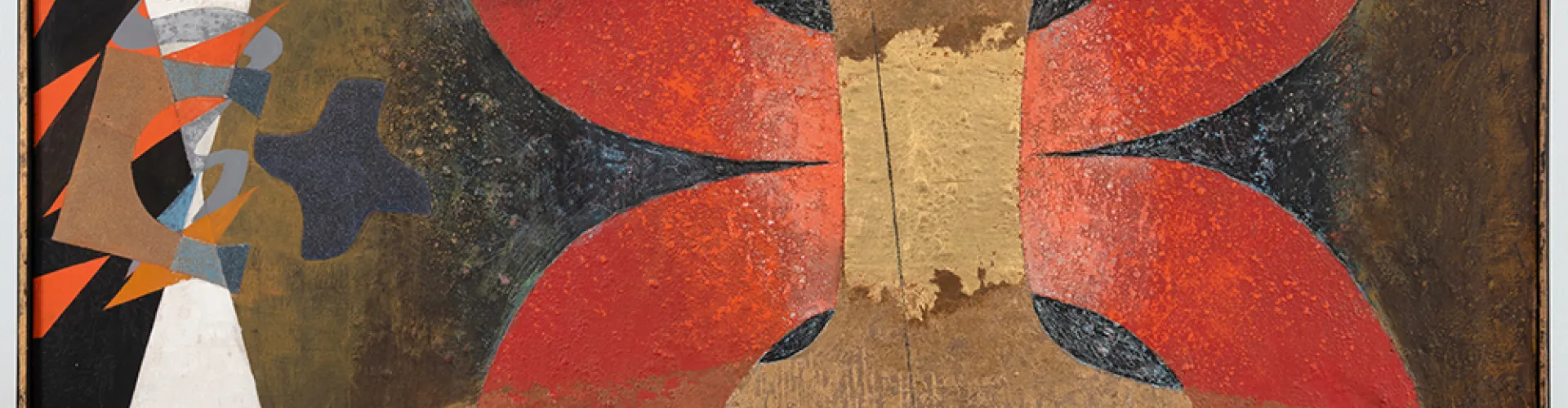
While attracted to figurative subjects, Jean-Marie Pirot was aware that abstract art could bring a new dimension to his painting by enabling him to express what he called his ‘secret garden’. During his three-year stay in Canada, from 1969 to 1972, he felt liberated from the expectations imposed by his growing fame. So he abandoned figurative art in favour of a formal exploration that led him to develop a repertoire of abstract forms. Lacking any precise meaning, these forms carried a symbolic resonance, the scope of which, according to him, he did not fully grasp. Following these pivotal discoveries, he decided to adopt the name Arcabas.
On his return to France, he re-appropriated figurative art without abandoning abstract art and combined these two approaches which, far from being at odds, complement each other through colour. In this way, Arcabas evokes the two ‘landscapes’ that unfold before him and which he carries within him: the external landscape, i.e. the personal vision that each of us has of the world and our surroundings and the internal landscape, i.e.our emotions, which are just as real.
THE POETRY OF EVERYDAY THINGS
Une poésie du quotidien
Arcabas was a Christian but not a religious painter. His painting is wholly focussed on celebrating beauty and he recognises its power to transform those who encounter it. For him, there was no such thing as the profane: everything is the work of the Creator and therefore sacred; everything deserves to be depicted and exalted. This was, in a sense, his creed.
Far from treating his still lifes as inanimate objects, he allowed himself to be imbued by the silent life that animates simple, everyday things around him. Everyday objects reveal much more than their mere function and a colourful dialogue opens up between an apple and a pear, or a handful of clothes pegs. The artist invites us to look beyond appearances.
Animals also have a life of their own. Arcabas observed them and depicted them in everyday settings. His dog, for example, can be seen in many of his works, but he also portrayed them allegorically, as in “The environmentally-friendly horse” in which the mare carries a message for humans.
SHAPING THE NARRATIVE
Façonner le récit
Through the abstract forms he integrates into figurative subjects, his use of gold as a colour, and his white backgrounds against which the composition flourishes, Arcabas creates a picture that goes beyond what is visible. Inviting viewers to step inside the painting, engaging all their senses through colour and its often dazzling effects, he arouses emotion through the freedom of his brushwork (e.g. the dual gaze of certain figures) and through the sense of the sacred evoked by gold. The viewing experience becomes active or meditative, and is often exhilarating.
Alongside the great biblical narratives, to which Arcabas adds his own perspective, there are also more domestic and allegorical scenes. Whilst the title of the work may guide the viewer’s interpretation, the artist’s ingenious ways of incorporating sound, movement and narrative into the depiction still remain to be discovered.
THE FEMALE BODY AND FEMALE FIGURES
Corps et figures de femmes
He was very inspired by biblical stories featuring female characters, as seen in his numerous portraits of the Virgin and Child in which ordinary young mothers embody tenderness, care and happiness. This deeply human depiction of Christ’s childhood illustrates one of the artist’s defining characteristics: his ability to paint both religious and secular subjects without distinction.
The figure of the mother – whether expecting a child or surrounded by her children – embodies the mystery and joy of procreation, which perpetuates life. Jacqueline, the painter’s wife, was his muse and faithful companion throughout his artistic career. She was the cornerstone of his family life and essential to his emotional well-being. The artist portrayed her in numerous paintings, either alone, next to him or to their children, or in the role of a model.
In his nude paintings, Arcabas captures the female form respectfully, rendering its intimacy in all its simplicity.
THE OUTRAGED ARTIST
L’artiste indigné
Arcabas was attentive to the world around him and he expressed his outrage in deeply committed works. Conflicts such as the wars in Algeria and Vietnam, as well as the torture perpetrated by Franco’s regime and South American dictatorships, rekindled the trauma he suffered as a child during the bombings.
He shared his convictions with a group of humanist and Christian intellectuals, notably those associated with the journal Esprit. He took part in a campaign called “Un Milliard pour le Vietnam” aimed at raising one billion old French francs for the North Vietnamese Red Cross. He also campaigned for peace during the 1968 Olympic Games in Grenoble and Mexico City, and more broadly opposed violence, injustice and cultural oppression.
He found the collusion of certain Catholic prelates with authoritarian regimes intolerable, and expressed this by caricaturing them in grotesque ways, often as Cyclops.
Sensitive to the plight of the most vulnerable, he used figures of animals to symbolise innocent victims of abuse, whilst biblical themes such as the Massacre of the Innocents or the adulterous woman took on a political dimension in his work, denouncing human barbarity as well as the predatory violence of certain men towards women, i.e. stoning, which remains a reality to this day.
THE CHURCH OF SAINT-HUGUES-EN-CHARTREUSE - THE ENTIRE WORK
L’église de saint-hugues, l’oeuvre totale
Whilst searching for a church to decorate in the early 1950s, the young artist Jean-Marie Pirot happened to visit the church of Saint-Hugues-en-Chartreuse which was under renovation. Impressed by its proportions, he offered to take on the task of transforming its interior and was given free rein by the parish priest, Raymond Truffot, and the mayor of the commune of Saint-Pierre-de-Chartreuse, Auguste Villard. The first series, unveiled in 1953, was followed by two more projects in 1972 and 1986. A final work, installed in 1992, brought this forty-year project to a close.
The final group consists of three painted panels, of different sizes, which interact with each other as they encircle the church. They are lit up by stained-glass windows and accompanied by sculptures and furnishings, all made by the artist himself. The works blend together harmoniously, reflecting the continuity of Arcabas’s inspiration and revealing how his art evolved, encompassing both figurative and abstract styles, expressing his vision of the world.
In 1984, the artist donated all one hundred and eleven pieces to the Department of Isère. The Church of Saint-Hugues, now the Arcabas Museum in Chartreuse is one of the most accomplished examples of twentieth century sacred art.
ARCABAS IN PUBLIC SPACES
Arcabas dans l’espace public
After being introduced to monumental art by his teacher Nicolas Untersteller, Jean-Marie Pirot began decorating buildings early in his career and continued to do so alongside his studio work.
His first commission was a fresco painting in a Savoyard chapel in 1951, followed by the ambitious project in the church of Saint-Hugues-en-Chartreuse.
Always keen to try different things, he broke with conventional artistic norms right from his very first commissions, exploring new techniques and deploying his artistic experiments on a grand scale. He approaches space with a vision he describes as ‘architectonic’, taking into account all its components, i.e. volume, colours, architectural aspects, light, circulation and purpose.
Before leaving for Canada, Jean-Marie Pirot applied for the so-called ‘one percent for art’ scheme, which allows contemporary artworks to be integrated into public infrastructure projects, and he secured numerous commissions (schools, the prefecture, the university). When he came back from Canada, parishes and local councils approached him directly, asking him to decorate their churches. This enabled him to create sets of works, particularly stained-glass windows.
Through his monumental works, Arcabas continued his quest for beauty and transposed his favourite themes into a variety of formats and techniques. Many of the artist’s works are freely accessible to the public and can be seen in the Isère region in particular.